Evidence of Neotropical carnivores' continental geographic range contractions over the last two decades
Abstract
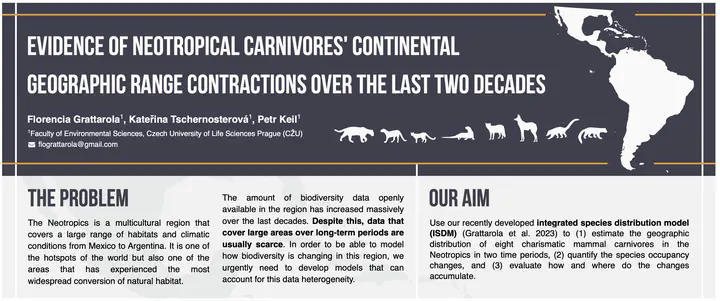
Anthropogenic changes can significantly impact the geographic distributions of species, causing range contractions or expansions. However, data to assess these changes are often insufficient, heterogeneous, and spatially and temporally biased. A promising solution to overcome these data issues is to use Integrated Species Distribution Models (ISDM). In this study, we aimed to assess the changes in the geographic range distribution of eight Neotropical carnivores using ISDMs. To evaluate how the species diversity and dissimilarity among assemblages changed, we combined presence-absence and presence-only data and modelled the species’ distributions at two time periods (2000-2013 and 2014-2021) using a Bayesian model based on a Poisson point process in JAGS. The model integrates the different data sources, accounts for sampling effort and spatial autocorrelation, and includes the species expert maps as a covariate (i.e., distance to the range’s edge). Our results show that most species decreased their ranges relative to the initial range size, and beta diversity in the region increased. We also reveal areas where contractions and expansions are accumulating. Our study illustrates the use of ISDMs to model the dynamics of the geographic range of species despite the data deficiencies. This modelling framework can be applied to assess other species and regions that also lack high-quality data, providing a promising solution to overcome the issue of high-quality data scarcity in the study of range dynamics.

Florencia Grattarola
Postdoc Researcher
Uruguayan biologist doing research in macroecology and biodiversity informatics.